History of Massachusetts
Landing, Survival, and Faith (1620s - Late 17th Century)
Mayflower and Thanksgiving: As we just discussed, in 1620 the Pilgrims landed at Plymouth. With the help of the Wampanoag Native Americans, they survived the harsh winter and, in the following autumn, celebrated a bountiful harvest together. This was the origin of “Thanksgiving.”
Strict Faith and Panic: Early Massachusetts was a purely religious society with extremely strict social rules. This repressive atmosphere peaked in 1692 with the infamous Salem Witch Trials, leading to the wrongful deaths of over 20 people. This became a profound lesson in American history about mass hysteria and judicial injustice.
The "Cradle of Revolution" in America (Mid to Late 18th Century)
By the 18th century, Massachusetts had become a vanguard in the resistance against British colonial rule. Bostonians naturally had a spirit of “Give me liberty or give me death.”
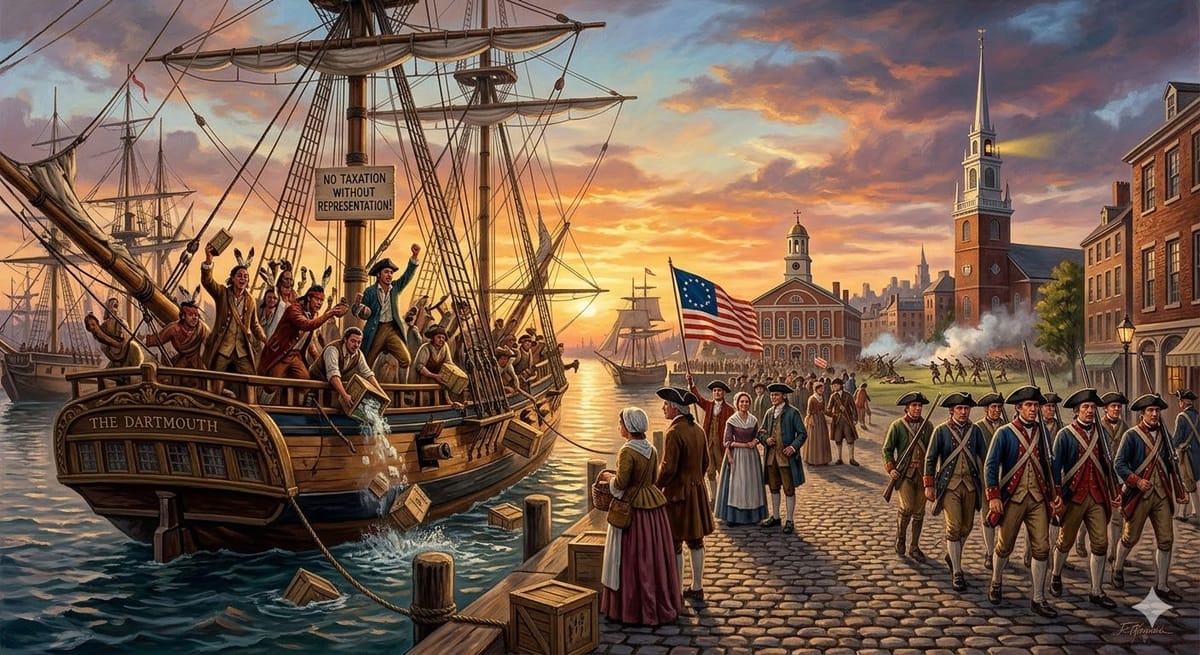
Tax Protests: Dissatisfied with heavy British taxation (“No taxation without representation”), the Boston Tea Party broke out in 1773, with angry citizens dumping hundreds of chests of British tea into the harbor.
The First Shot: In 1775, British troops marched to Lexington and Concord to search for weapons, and local militias fought back. This is known as “the shot heard 'round the world,” officially kicking off the American Revolutionary War in Massachusetts.
Heart of Industry and Beacon of Freedom (19th Century)
After independence, Massachusetts did not slow down; it experienced explosive growth both economically and intellectually.
Pioneers of the Industrial Revolution: Cities like Lowell in Massachusetts established huge water-powered textile mills, attracting large numbers of young women (the “Lowell girls”) and later European immigrants. This became the engine of the American Industrial Revolution.
Abolition Movement and Intellectual Awakening: 19th-century Massachusetts was a gathering place for American intellectuals. It produced great thinkers like Emerson and Thoreau, and was at the heart of the abolition movement (opposing Black slavery). During the subsequent Civil War, Massachusetts not only provided money and arms but also sent the first all-Black regiment (the 54th Infantry) to fight for freedom.
A "Super Brain" for the Future (20th Century to Present)
In modern times, as traditional manufacturing declined, Massachusetts successfully transformed itself into a global hub for education, healthcare, and technology.
Academic Sanctuary: Massachusetts is home to over 100 institutions of higher learning, including the oldest in the U.S.—Harvard University (founded in 1636, 140 years before America’s independence!)—and the Massachusetts Institute of Technology (MIT).
Politics and Technology: The famous Kennedy political family hails from here. Today, Boston and its neighboring cities (such as Cambridge) are the “Silicon Valley” of global biotechnology, pharmaceuticals, and computer science.